Random Quote

(Loading...)

Powered by Ink of Life

Saturday, September 14, 2024

Ducks


Glorantha & Ducks

Sorry for the long delay in posting, been working on ducks. Now now, before you run off in boredom, these aren't your average ducks. They're role-playing ducks! Still bored? Okay, well then I would suggest you just run along because it's going to get pretty duck-heavy in these here parts.

So I do editing for a bunch of fine folks, mostly games, but not all. Drew and Neil are two gentlemen behind numerous game supplements for use in the Glorantha setting from Chaosium. The most recent release is Book 4, Volume 1 in their Duckpac series. 

I contributed so much to this manuscript they decided to list me as one of the authors! How cool is that? But they really do deserve all the credit. I just polish their genius so it shines like a diamond. If diamonds shined. Which they don't. But that's neither here nor there. Sorry, the science teacher in me came out for a second. But if you've read this far and are still interested, go grab a copy, either pdf or the good ole-fashioned paper stuff. 

Link: Duckpac Book 4, Volume 1


More about what it contains in the next post!


Maybe one more thing. I am trying to step up my online game and thus have created a simple logo for this blog. And here it is!


And even a little moving one!


Sunday, August 25, 2024

Door Number Green

A short story for today and some artwork. 

Door Number Green is a short story based on a prompt. 

The butterflies at the bottom are from my daughter, drawn for another release.


*~*


Door Number Green


Moses pounded on the door. His po-po knock, as his wife called it. It often came in handy in getting people’s attention. He needed it now. Desperately. He shifted his burden, pounding again with weaker, icky thumps smearing red across the green paint.

“We don’t—”

“Open the door!” he roared. “I’ve got wounded!”

The door swung open and Moses fell in. Someone dragged him and his ward into the foyer before slamming the door.


Moses woke, blinking rapidly at the harsh light. He was on a bed in a small room with one closed door. On one side was a nightstand beside an elderly gentleman in a wheelchair at the bedside. On the other side of the bed hung a bloodbag and saline connected to his arm.

“Where is she?” Moses tried to rise, but a gently placed hand and the tourniquet still in place encouraged him to stay put.

“Somebody did you good, my man.” The old man’s voice was a raspy whisper.

“Where is she?” Moses repeated.

“She’s recovering. Same as you. It’s a miracle, it is. My nurse can tell you more. We heard the news of course but we didn’t believe it. Can you blame us? All the fake news out there these days. Where was she?” The man’s milky eyes glimmered with hope.

A soft knock at the door was followed by the entrance of a large male nurse. Moses caught a glimpse of his gear in the hallway. 

The nurse talked as his hands busied themselves, checking bandages before pausing at the windlass. “Hi. My name is Sam. I’m Mr. Johnson’s home health nurse. I patched you up best I could. Luckily you and Mr. Johnson are both O+.” Sam undid the strap holding the windlass in place. “Now this is going to hurt.”

“No shit.” Moses took a deep breath, which confirmed at least one broken rib. “Do it.”

Moses groaned as his leg began to tingle with returning pain. The agony was raw and monstrous but tolerable.

“I gave you Dilaudid earlier. Let me know if you need some more.” 

Moses shook his head. 

“Your plates stopped most of the rounds, but I counted eight new holes in your body. That is not good for your health.” Sam redid the tourniquet, winding down the windlass and securing it in place. The minute of blood flow soaked several of the bandages around Moses’ calf. “Bad news is you’re probably going to lose the leg below the knee. Good news of course is now you’ll have a matching pair.”

“Where is she?”

“Was she at the park?” Mr. Johnson asked. “I always imagined someone would find her there.” His hands shook. “Tell me.”

“She’s in the kitchen. A few injuries. She’ll be fine. You did good, Moses. Some will call you a hero. Of course, most won’t. Boy did you pick the right house at the right time. I was just getting ready to leave when you pounded on the door!”


Sunday, September 25, 2022

New Release Coming in time for Halloween!

Hello All you Cute Bats & Mittens!

I have a new short story coming out, just in time for Halloween! It's part of a Wolfsinger Publications anthology titled Never Cheat a Witch.


The prompt for the anthology revolves around the idea inherent in the title: cheating a witch is a bad thing to do. I took that idea and wrote a story about a village that needed help in dealing with a witch they had wronged. Titled Isabella the Eldridge, the short story is filled with magic, werewolves, magical trees, faithful villagers, loving grandparents, and witches that hold grudges.

Here is a piece: 

Amidst the waste, slop, and vile run-off, wrapped up in old rags, looking like nothing more than another pile of refuse. The Old Blind Woman. They say she gave up her sight to punish someone who wronged her. A last, desperate trick. What-ever the truth was, it was plain to see she was a witch with nothing left to lose.

I crouched down beside her. A rat screeched nearby, annoyed at my presence no doubt. “Megarith?”

The pile of rags shifted. Moved. Muffled, a coarse voice whispered, “She needed the babe. Powerful magic in a babe.”

“What?” I asked.

“You were about to ask me what she needed the baby for. Or have we reached that part yet?” The Old Blind Woman yawned, stretched. “Dark magic.” She unfolded her legs and lifted a rag off her head. I saw the stories were true. Deep scars surrounded empty sockets. What a mess. The patchy remains of her thick eyebrows danced like hairy warts as she grimaced and scrunched her face. “After being roasted in an oven, together with a few other savories, and then ground to powder and ashes, she would use the material in certain spells and potions.” She sounded as if she recited a treasured family recipe for pot roast. “Or she could have wanted to transform the baby into something else.” A wrinkled hand reached up and wiped the drool from the corner of her mouth.

I fell back on my butt, stunned.

The rat chittered and squeaked.

“Yes. He should know better. Never cheat a witch,” she cackled. “They will make you rue the day and the night for the rest of your short, pitiful, life. Trust me, I should know.”


There are a lot of other talented writers in the anthology as well. I'm looking forward to reading their stories. The titles look intriguing. Below is a table of stories and authors:

Acts of God, by Ian Kitley

Skulls on a Shelf, by Jodi Rizzotto

Better than Gold, by T.W. Kirchner

Law of Spells, by Lea Storry

Subscribed, by Louise Zedda-Sampson

No Age Restrictions, by Danielle Mikals

Fair Trade, by Dominick Cancilla

Dream Weaver, by Wendy Harrison

Can’t Be Done, by Elle Hartford

Dwarves, Donks, and Death, by Brian MacDonald

Mike and His Three Lives, by M.A. Lang

Book and Key, by J.L. Royce

Isabella the Eldridge, by Frank Montellano

Hex, by Clark Sodersten

Paper Mage, by Sandra Unerman

Controlling the Kudzu, by Bailey Finn

The Friar and the Turnip, by Christopher Wortley

How to Steal a Spell Book, by Mirabelle Poppy

The Frog and the Princess, by Jean Martin

Marigold at Midnight, by Tyree Campbell

Learning Something Useful, by Joyce Frohn

Night Work, by Rose Strickman

Breaking Down a Cursed Sandwich, by Ray Daley

Paybacks a Witch, by Harriet Phoenix


For those interested, my title has a deeper meaning not mentioned in the story. Isabella the Eldridge is a mangling of Isabella the Elf-Bridge. The title witch is friendly to elves, functioning as a sort of connection between our world and theirs. If I ever write more of the tale, there is plenty to work with. 


All for now,

Frank


Saturday, April 2, 2022

Descriptions & Time Capsules

It's been a quiet bit of time on this blog, nearly a year, but for good reasons. I've been busier than usual and reflections and expansions of the written sort have taken a back seat.

So let's catch up on some news, eh? I have two new stories out! One is my typical fantasy fare, good stuff and I'm proud of it. The other is a piece of realistic fiction. Also good, and also proud of it. You can find both stories in the Time Capsule anthology released by Wolfsinger Publications.

The first recent story is called How the Wish was Won. It was based on a selection of time capsule contents. While there is no one single protagonist, there is a brave and gallant knight, a possessed soldier, an unpossessed soldier, a mysterious underground creature, and a woman of the woods, along with some elvish lore and an ancient outpost in the deep forest.
Here is an excerpt:

Five seekers quested for their Heart’s Desire. One from the east, one from the west, and two from the south.
The fifth seeker, you ask? No cardinal direction guided its way. Its dark path twisted and turned in the unlit underground. And yet it too quested, the same as the others.

<script async src="https://pagead2.googlesyndication.com/pagead/js/adsbygoogle.js?client=ca-pub-5008135905106147"
     crossorigin="anonymous"></script>

The whole idea of hiding something away fascinates me, especially with the recent find of not one but two time capsules beneath a civil war statue scheduled for movement elsewhere. Time changes, changes more than anyone can predict. The stories hidden inside this anthology were written with this idea in mind, that things change over time. Authors were given lists of time capsule contents to choose from, with no clues as to why the items were originally sequestered. With a list and nothing else, they came up with fantastic stories that bear a tangential tie with the original depositors, as discovered by the notes from the capsule content authors at the end of the story.
For those who wish a peek behind the writing curtain, my two stories evolved in very different ways. For How the Wish was Won, I ran the story by a few readers, including my youngest daughter. An interesting note is that all readers so far have come away with a different idea of the ending! What will you find when you buy it?

Here is another sneak peak at How the Wish was Won:

Sanders and Palmer dug into the black earth, occasionally stopping to vomit. The ground came away in shovelfuls. The men looked at each other with insane glee. They would find the treasure!
With a wounded retch of rotted roots, the earth caved in, throwing them into a hollow nestled among the roots of the trunk.
“What in God’s name?”
They coughed and hacked as the air cleared. By the sunlight they noticed a small tunnel leading away.
“Drag marks. Look. Someone got here first.”


My second story in the anthology is The Importance of Things, a piece of realistic fiction. Unlike the first story, this one came fast and furious. Deadlines are great at inspiring lazy writers and Carol Hightshoe is a wonderful motivator! Although not fully noted in the story, it is located in a particular place within the continental United States, and I hope readers from the area will recognize it. The people at the heart of the story are not real though. They are, like most literary inventions, fictitious blends of various characters I've been or have had the misfortune and/or good grace to stumble across. I hope I did them justice.
Here is a sneak peak at The Importance of Things:

“Daddy found it in the backyard.”
“Yes, well. That’s where I buried it. Forgot about it back there.”
They both stared at it.
“What is it?”
“It is a time capsule.”
“Time? Like a clock?”
“Don’t they teach you nothing in schools these days?”
“I’m only in second grade,” Tommy said with a pout.
“No excuse.” His voice held an edge. Tommy cringed, but Grandpa Tom only ruffled his red hair.


What did Grandpa Tom bury in the backyard? Buy the e-book and find out! You can find both stories in the Time Capsule anthology released by Wolfsinger Publications. Other authors in the anthology include Deby Fredericks, John Lance, Dana Bell, and Ryan Kinkor.


****
Never have I read a more accurate description:

"One woman makes a din, two women a lot of trouble, three an annual market, four a quarrel, five an army, and against six the Devil himself has no weapon."

Mad Griet, from the Flemish. Must use this somewhere in my writing.

Sunday, April 25, 2021

Inspirations & Motivations

A writer friend of mine recently asked two questions: 

1. Where do you get your inspiration and your motivation from?
2. What do you do with bits of inspired writing not long enough for a story? 

Inspiration and motivation can be found all around us. Movies for instance. 

Dr. Zhivago
Dr. Zhivago, a story of Russia in the days of the Revolution, wrapped around a love story. But it starts off so dark. In the opening scene of Dr. Zhivago, one of the characters says, "There were children in those days who lived off human flesh, did you know that?" 

Who would write a love story that starts off like that? A guy named Boris Pasternak, who was awarded the Nobel Prize but couldn't go get it. His life was something else, worthy of its own read. For example, the Russian government threw his girlfriend in the gulag for three years because they didn't like what he was doing.

Writer Stuff:
Inspiration and motivation can even come from simple knowledge. Like the following: 

MacGuffin: (n) An object or device in a movie or a book that serves merely as a trigger for the plot. I recently watched another classic: The Maltese Falcon. The statue at the heart of the plot is a perfect example of a MacGuffin. The whole movie revolves around this statue. Definitely inspirational. The Lord of the Rings anyone? Another series set around a MacGuffin. You can do it too!


Obvious State: A website with some excellent literary quotes and fantastic accompanying pictures. One of my favorite, which I was unaware of, was this gem: [Exit, pursued by a bear]. That's a stage direction from William Shakespeare's A Winter's Tale. I won't get any money if you follow the link, I just think it's a good site for motivation. Writers should want their writing to be good enough to be turned into a work of 'art art' to mirror the work of 'word art' it truly is.


French Opera
I absolutely enjoy having friends from all corners of the globe. It exposes me to so many things I would never come across. Like this: a small snippet of song, from one of my writer friends overseas (Howdy AJ Jon!). I reviewed a piece of work by him and some others and they inserted the following lyrics at the beginning of their story, which was about a girl who loved the opera. 

passons nos jours dans ces vergers, 
loin des amours et des bergers,
passons nos jours, 
passons nos jours, 
loin des amours et des bergers

[translated from the French]
Let's spend our days in these orchards, 
far from loves and shepherds, 
let's spend our days, 
far from loves and shepherds

So simple, so powerful. Though I am a little confused on why the shepherds need to be distanced from, lol. The lyrics are from Pomone, considered to be the first truly French opera. Composed by Robert Cambert, Pomone premiered in 1671 during the reign of Louis XIV. You can get some more information and hear the song here. I guess the lesson here is to cultivate friends from far afield, and with different interests than yours, besides writing of course.


That'll do Pig. That'll do.
And lastly, one of the most powerful motivators comes a job well done. The following is a missive from one of my recent editing jobs (slightly edited for anonymity): 

"I started reading the first six chapters. I cannot believe how you have transformed my book. It is so much better! It just tells me how much I have to learn. I will finish reading it this week.

I would just like to say thank you so much. If the rest [of the book edits] are as good as the first six chapters, I am going to be a very happy man. 

I really can’t thank you enough. Let me know when you want the final payment and I shall send it to you. I look forward to working with you on my future books.

A very grateful [Author]

I am grateful to be able to work with such wonderful authors. He is a huge motivation for me to do my best! 

Now go forth and write!


Sunday, January 31, 2021

Dave Owens: How to Tickle the Muse

Howdy All,

Here, today, we have for your perusal another fine bit o' advice for you to chew on. Dave's the man. Learn his lessons well and you too shall prosper with the words. My only regret is it's not an epistle. Heaven knows I yearn for a good one of those. Ah well, maybe next time. Until then, feast your eyes on...


How To Tickle The Muse
By David Alan Owens

Unless you do the work, the world will never see your vision. -Jocko Willink

Today I wrote and revised for 3 hours. My usual activity for early morning. Not much actual writing today, but I scoured one of my stories in progress. I reset the anticipated plot, rearranged the sequence, researched clothing worn by the characters, pasted the images into my story for future reference, and deleted much of the material already written. I am never satisfied, nor should you be satisfied. When a writer becomes satisfied, he's made his first mistake.


Traits a good writer must pursue with vigor:

Writers must be great observers. We watch people, their actions, the little things about them, how they dress. We wonder whether their clothing fits properly. We store the data in our memories, because somewhere in the future, we know we will need the persons we watch to create memorable characters in our stories.

Does the person limp, walk with the aid of a crutch? Does the person strut the walk of self importance – keep him, you'll need him. Does the woman wriggle her hips when she walks, or is it the tall walk of confidence. The boy on the street. Is one of his front teeth missing? What is the appearance of the child's clothing. Readers will remember the child because of his missing tooth. Anything less than focused observation will cause the writer to write stick figures or cardboard characters.

Appearance and physical traits reinforce the character for the reader's pleasure. The same elements drive “Show Don’t Tell.” Ask yourself this question: “Do I love the character, or did I write them flat?” Love your antagonists as much as your heroes. Know all of your characters – write depth of character, and not poor images copied from movies we've seen. Create original characters. Originality is what sells.

We must become great listeners: To listen, instead of speaking, teaches us many things. We learn dialect nuances, speech patterns, rhythm patterns, oddities – a "lisp" for example, might well be usable in a story. Then we must write the "lisp,” because unlike movies and films, we must convert a characters' vocal traits into written words. Not an easy task, and one of the weaknesses I always find when I edit. No matter what your pursuit, when you listen carefully you learn. Turn your mind into a recording device. Store the information you hear in your memory. When one injects himself into learning, the power of the lesson vanishes. Ask this question when you write dialogue: “Does my dialogue read like real people speak? Do they all speak in the name manner? What variations do I employ to differentiate them from each other?”

Writing is art: The story is the core of our art, but it isn't art. Dynamic characters aren't art. Beautiful scenery isn't art. Plot isn't art, but a road map. The smart writer knows the map is not always the correct map. Why? Because a plot rarely survives the scrutiny of an editor. Create a solid Map and revise it often. Discard if the map doesn't take the reader where it should. Find the treasure, and don't randomly search for alternate routes. Find the true map during revision.

A simple change in a character can disrupt the plot. The process requires delicacy not force. When you force the story, you will always fail. I'm living proof.

 Writing is craft: Writing is also something more. We strive to master the craft, but we are practitioners in a craft for which there are no masters. Great stories require a balance between art and craft, but unless the two merge, the story may flounder. This is the point where edit and revision reside.

I’ve talked with writers who think an edit is revision. Well, sort of, but revision is far more difficult than an edit. Proper revision is a destructive process. Destroy and rebuild.

What is an edit? Edits involve a broad scope of knowledge. Grammar, word choice, and punctuation rule the edit. Some forms of edit involve story only. Line edits probe deep into the words and structure, and revision hovers alongside the editor, but the line edit is not a revision. Complete the laborious spelling and grammar check. Solid inspection is a must. Technical elements. Examine the technical aspects of your writing. Edit without mercy. Edit with vengeance. If you don’t, an agent or publisher will know. Most editors and agent can recognize the quality of a manuscript in just eight lines. Eight lines. Those first few lines tell the agent/editor everything they need to know about your style. Is your style strong, does it help create a great hook, or is it dependent upon common weak techniques copied from other writers?

Revision. Now comes the time to “kill darlings.” In revision everything is “fair game.” In addition to the ever-present editing factors, revision digs deeper. The process is intense. Question everything to make sure the writing, characters, setting, plot, plot structure, grammar and punctuation is the very best you can do. It’s a tough process and consumes much time if you revise properly. Avoid shortcuts. Get it right and you’ll find that elusive “satisfaction” —maybe. Does what you’ve written reveal the true story you intended?

Originality: Vibrant writing holds the reader. Hemingway said, “Motion is not action.” What’s the difference? Sometimes the line that separates the two is narrow.

Examine this sentence:

“I’ll get some,” he said going to the refrigerator, opening the door, taking out a bottle of milk, and opening it.

Everything after “he said” is motion and an awful dialogue tag. Stick with said or asked.

Action version. Notice how word count and interest increases.

“Hey. Get me some milk,” Carol said. “I put a fresh bottle in the fridge yesterday.”
Jack wanted to say, “Get it yourself,” but he changed his mind. Like an obedient servant he went to the refrigerator and opened the door. The pungent odor of rotted vegetables assailed him. “Yuck. When’s the last time you cleaned this thing?”

“Just get the milk and quit your whimpering.”

(Did you notice the second sentence Shows instead of Tells?)

Don’t revise for yourself. Revise for the reader. Always for the reader.
Your first reader may be an agent, editor, or publisher. Your story reflects who you are as a writer.

Don’t skimp—give ‘em a five course meal with dessert. Cheesecake anyone?

-Dave Owens


Thursday, December 31, 2020

The Year of Bad and Lorelei

31DEC2020 - 01 JAN 2021

It's typical to do an end of the year post, right? Well, I haven't posted in a little while, so not only is this a 2020 wrap-up, but it also contains a few other subjects that have been waiting for me to publish. It's a good thing I haven't posted in a bit, means I've been busier than usual.


The Year of Bad

This year...ugh. Started out pretty normal and then, the news started talking about a novel coronavirus. From China. I remember in March, listening to an African-American say, "I'm not worried about COVID, my Auntie told me Black people don't get COVID." 

Little did we know back then. 

I wasn't able to go to my normal work for several months, in fact all the way to summer. COVID meant more work as I adjusted to working from home, at least trying to. Learned a few new tricks, not bad for an old dog.

Summer was a time of worry instead of relaxation and renewal. What would Fall bring? And then when I was able to go back to work, I had to wear a mask all day. That was, is, a lot. It's not 'wear a gas mask for 8 hours' bad, which I've done before, but it is an extra distraction. Try talking through a mask for seven hours a day. 

We still have toilet paper in the garage, and Clorox wipes, just in case another shortage hits. Kobe is gone. Our Christmas Tree ornament this year is a "dumpster fire" ornament. How appropriate.

In authoring news, I re-released a short story this year (The Legacy), an expansion of a previous release. One of my favorite stories actually, and one I hope to revisit again in the coming years to write a sequel or a prequel. I had so much fun expanding it that I might do the same for a few other stories. 

I have a few short story commitments to fulfill at the beginning of the year, one about dragons! Another one is about a time capsule, and a third one I can't say anything about yet, but it's right up my fantasy alley. I'm real happy to work with a publisher I've worked with before.

The short story compilation I am planning on releasing is still in the works, but my energies this year have been focused more on editing. I did several editing jobs for various clients this year, and am finishing out the year working on two more of them. All met with satisfaction and actually earned me more than my writing did this year. They were a lot of work. But of course editing is writing as well, as the editing jobs included all levels of editing, from straight proofing and copy editing all the way to developmental editing, structural editing and marketing material/blurb writing. I even did some decent graphical work. I really have to get back into that. I love graphics. 

A piece of graphic work that probably won't see the light of day anywhere else (from The Canterbury Tales by Chaucer): 


And yes, it's all spelled correctly, at least for the English of that time. It's about as legible to us today as textspeak would be to Chaucer. I can't imagine what English will look like in a hundred years' time.

So some good news and bad news. Good news, authoring/editing revenues are up. Bad news, not much of my own material released this year. I hope to release more next year! Come on 2021!

A bright spot of news in the Year of Bad! Wolfsinger Publications is ramping up publishing again! The owner, editor, publisher, wearer of all hats, Carol Hightshoe, is amazing and wonderful. She has some calls for anthologies out, and is releasing several books this year!

Another indie press outlet, one I haven't worked with yet, is Black Hare Press. They have several interesting anthologies out, but some of them are only available to authors they have published before. 

Piece of secret knowledge for today: Dryads become air elementals after the death of their tree...They fly away fly away fly away free. Anyone who tells you otherwise is One of the Unknowing...

Picture for today: A scene from the ancient tale of Tristan and Isolde. Various spellings, languages and details aside, it is a tragic tale of love and betrayal. One of my favorite adaptations is actually a science fiction version of Camelot in the future that incorporates the doomed pair (Camelot 3000)! Here the two title characters are getting ready to drink a love potion together. For those interested, this picture is free to use, according to the Wikimedia commons. 


No resolutions for the coming year. Bring it on!

Love to all, hope your New Year is in all ways better than the old year! Salud!


Saturday, October 24, 2020

Light is the Shadow of God

I don't talk religion on here or anywhere else, so bear with me. Not going to really talk religion, but I'm going to get super close as I discuss a few words from an old philosopher. 

Consider the following: 
"Light is the Shadow of God." 

Plato, Greek philosopher from Athens said that. About 2,400 years ago, along with a bunch of other cool things.

That God is so bright his shadow is what illuminates our world. Shooting stars, sparks from flint, lightning, the flame of a lowly match, sunlight, moonlight, bio-luminescence, any source of light is a glimpse of the shadow of God? 

That which what we see by is His shadow. That is pretty deep. Perhaps Plato believed people could not withstand the direct sight of God. I wonder what he would have thought about Marie Curie's discovery? Further emanations from God?

Light is the Shadow of God.
As writers, what can we get from this? 
Two things:
  • One, I think it talks to the process of showing not telling. Writers don't need to describe everything in detail, leave something to the imagination. Light is the Shadow of God. 
  • Two, as writers we need to stretch our imaginations, use words and meanings for purposes and definitions they weren't meant for but that lead the reader to where you want them to go. Light is the Shadow of God.

~*~

Picture for today is from Anthony Chapel, just outside of Hot Springs, Arkansas. I love this photograph. It is a delicate, abstract interplay of lines, light and shadow, and as a place where people come to be bonded together in the eyes of the Lord, I assume His direct emanations are in there too somewhere. 
We just can't see them.
But they are there, nonetheless. 
Look for them. Not with your eyes, for your eyes are unable to see, but with your soul. 

Contemplate. 

Light is the Shadow of God...


See, told you I wasn't going to talk about religion, but I did get really close.

Saturday, September 19, 2020

Songs in Stories - Stories in Song: Long Lankin

Howdy all you cool cats and kittens! Yes, I watched it, my wife made me, lol.

Songs in Stories, Stories in Songs

Something a little different today. 

I stumbled across this old gem whilst wandering around the internets late one night. It's a ballad called Long Lankin. The most common versions are about a stonemason who takes revenge on a Lord for not paying the mason for his work. The mason enters the dwelling he built, sometimes through a secret catch or entry he designed, and lures the Lady downstairs by poking her infant over and over again with a needle, causing him to scream in pain of course. The wet nurse caring for the child calls for the madam to come down because she can't get the baby to stop crying. The mason then kills both the baby and the mother. He is punished for his deeds, usually through hanging, along with the wet nurse. Nothing more is said of the Lord whose refusal to pay caused all of this mess in the first place.

That this was a popular ballad, sung by women no less, is something of a head-scratcher for me. Why would women want to sing a song about a treacherous nurse, the killing of a Lady, and hangings?

There are other notable versions and histories of the ballad out there, such as the roots of this ballad may have something to do with old rituals of 'blooding the foundations' of new buildings with a sacrifice, and the mason in some versions is a leper who used a silver basin to catch the blood of the baby as a possible cure for his disease. But I get ahead of myself... 

Here is the ballad, sung by the band Steeleye Span, for your ears to feast on. Lyrics below the lace picture, which I promise will make sense down the road.


Long Lankin
Said my lord to my lady, as he mounted his horse:
"Beware of Long Lankin that lives in the moss."

Said my lord to my lady, as he rode away:
"Beware of Long Lankin that lives in the hay."

"Let the doors be all bolted and the windows all pinned,
And leave not a hole for a mouse to creep in."

So he kissed his fair lady and he rode away,
And he was in fair London before the break of day.

The doors were all bolted and the windows all pinned,
Except one little window where Long Lankin crept in.

"Where's the lord of this house?" Said Long Lankin,
"He's away in fair London." said the false [wet] nurse to him.
"Where's the little heir of this house ?" said Long Lankin.
"He's asleep in his cradle," said the false nurse to him.

"We'll prick him, we'll prick him all over with a pin,
And that'll make my lady to come down to him.'

So he pricked him, he pricked him all over with a pin,
And the nurse held the basin for the blood to flow in.

"O nurse, how you slumber. O nurse, how you sleep.
You leave my little son Johnson to cry and to weep."

"O nurse, how you slumber, O nurse how you snore.
You leave my little son Johnson to cry and to roar."

"I've tried him with an apple, I've tried him with a pear.
Come down, my fair lady, and rock him in your chair."

"I've tried him with milk and I've tried him with pap.
Come down, my fair lady, and rock him in your lap."

"How durst I go down in the dead of the night
Where there's no fire a-kindled and no candle alight?"

"You have three silver mantles as bright as the sun.
Come down, my fair lady, all by the light of one."

My lady came down, she was thinking no harm
Long Lankin stood ready to catch her in his arm.

Here's blood in the kitchen. Here's blood in the hall
Here's blood in the parlour where my lady did fall.

Her maiden looked out from the turret so high
And she saw her master from London riding by.

"O master, O master, don't lay the blame on me
'Twas the false nurse and Lankin that killed your lady."

Long Lankin was hung on a gibbet so high
And the false nurse was burnt in a fire close by.

There are many versions of this song, once used by European lace workers in the 18th century as a 'lace tell', a tune to keep their fingers fiddling in correct cadence. The version above is from The Penguin Book of English Folk Songs, by Williams and Lloyd. The list of songs inside can be found here. 

Upon further diving, I discovered a few other possible meanings for the words of the song and came up with an interesting story idea. What if the song were a hidden lace pattern? See if you can follow the crumbs as I weave together true facts and fiction and create a story from a song, but not the one you hear...

The name Lankin (in some versions the name changes to lambkin and other names which further muddle possible meanings) can be tied to Lanking pins, which are pins that have a conspicuous head, placed along the foot and the head of the lace in order to keep a firm edge. There are also Long Toms, which is a name for general purpose pins. Could the name Long Lankin be a combination of these two terms, and meant to tell a lace worker what pins to use? All without a non-lace worker's knowledge? 


The whole ballad then becomes a hidden lace pattern. Start working on the 'building', maybe some fundamental lace pattern that all lace workers would know. It has an lower and upper floor, so maybe it has two main portions or patterns? Then the lace worker stops at a certain point and 'asks for payment' (the main pattern is stopped and the lace worker switches to something else, maybe takes a break, maybe uses a different type of thread, starts a frill pattern or a simple pattern known as the Cheapskate). 

No payment is forthcoming, so we sneak in (start a new lace that interlaces with the main base pattern at a certain point) and 'poke the baby' over and over (not sure what this would correspond with, maybe some very delicate or intricate work at the heart of the pattern or along the bottom portion of the main pattern). The wet nurse on the main floor (a specific lower portion of the main pattern such as a rose or design) calls the Lady down (maybe Lady refers to a rose or design that's fancier than the wet nurse, and calling the Lady down means attaching a portion of the upper part of the lace pattern with the invasive stitching)? 

Can you see the story and lace pattern coming together? Other key words in the ballad can direct the lace worker to add certain flourishes or details. I am not sure what this pattern creates, but I could see it being used in a story somewhere as a way for a seemingly harmless lady creating something plot-advancing.

When writing tunes for your own manuscripts, keep in mind that they should do something more than entertain musically. Does the song move the plot along? Does it provide background, world-building, or another way to dump information? As long as it serves some function, then go ahead!

And now I got to get on this hidden lace story! 

Happy writing to all!

Tuesday, August 4, 2020

Tuberculosis versus COVID-19

04 AUG 2020
[for those who care about this sort of thing, this was also put out on my FB page as well. I decided to include it here for wider coverage]. Sorry in advance for yelling...

Tuberculosis (TB) vs Covid-19

I've seen too many shared posts about this. So let me see if this former science teacher can spread some truth...

There are posts going around saying "why are we shutting down the world for COVID-19 and not for TB?"

SHORT VERSION: You should worry about COVID-19 way more than TB. How much you worry about COVID-19 is up to you. A little over five hundred TB deaths in the US for 2017. COVID-19 US deaths in the last seven months: 159,000 and counting...You do the math...

*******************************************************

Some TB data: About 1.5 million people died from TB in 2018. That's a lot! This works out to more than 4,000 deaths a day due to TB in 2018. So how come we're all up in arms about COVID-19? Why not shut down the world for TB?

TB, if untreated, has a mortality rate of 45%! OH NO!

What's the mortality rate of COVID-19 you ask? Well, the easy answer is COVID-19 is too new to nail down the mortality rate. We don't know exactly how many cases there are, for several reasons. For example, not everyone is getting tested before/after passing away. Some reports estimate mortality rates for COVID-19 anywhere from 1.5% to 20%, with 20% being the super high range of the estimates for Wuhan, China, where the virus first showed up. Until we get more accurate numbers for who does and doesn't die from COVID-19, we won't be able to nail down the mortality rate for COVID-19 for a while yet.

But how about this to scare you a bit? The CDC is already pretty much guaranteeing COVID-19 is going to be one of the TOP TEN causes of death in the US for 2020. L.A. Country has already said this as well.

FYI: Here are the top 15 causes of death in the US for 2017 (lots of bad things on the list to watch out for -TB is not one of them):


1. Diseases of heart (HEART DISEASE) 647,457 deaths
2. Malignant neoplasms (CANCER)
3. Accidents (unintentional injuries, OOPSIES)
4. Chronic lower respiratory diseases 160,201 deaths
[current COVID-19 deaths in US is right here...]
5. Cerebrovascular diseases (stroke) 146,383 deaths
6. Alzheimer disease
7. Diabetes mellitus (diabetes)
8. Influenza and pneumonia (FLU)
9. Nephritis, nephrotic syndrome and nephrosis
(kidney disease)
10. Intentional self-harm (SUICIDE)
11. Chronic liver disease & cirrhosis (some by over-drinking)
12. Septicemia (blood poisoning)
13. Essential hypertension and hypertensive renal
disease (hypertension, HIGH BLOOD PRESSURE)
14. Parkinson disease
15. Pneumonitis due to solids and liquids (LUNG INFECTIONS)

TB, if untreated, has a mortality rate of 45%! Super deadly you say! BEWARE! But TB, unlike COVID-19, is not only PREVENTABLE, but it is also TREATABLE. WHO data says global success rate for people who started TB treatment in 2018 was 85%. The 45% mortality rate is for people who don't get treated for it.


So, TB, if untreated, is technically way way deadlier than COVID-19. Nearly half of the people with active, untreated TB disease may die, much more than even the highest mortality estimates for COVID-19.

So, how come we don't shut the world down for TB? Well, we have treatments that work for TB, even the drug-resistant varieties. Right now there are no proven treatments for COVID-19 except supportive treatment, however there are many trials underway right now that may lead to workable vaccines and care regimens.

Tuesday, July 28, 2020

New Story - Thieves' Oil

28 AUG 2020

[I started this post in May, but events, pandemic and otherwise, pushed it to the back burner until now...]

Starting off this post with a pair of quotations:

  • *Author Charles Godfrey Leland: "...witchcraft, like the truffle, grows best and has its raci[e]st flavour when most deeply hidden."
    • What a great way to conjure up an image through comparison.
  • Lactantius (an early Christian author who became an advisor to the first Christian Roman emperor, Constantine I): “Devils so work that things which are not, appear to men as if they were real.”
    • What a great way description from back in the early beginning of the Christian religion.

Saturday, July 18, 2020

Through the Lens

Well, I just posted a short story in progress, and I was pretty happy with that side of my creativity, so let's do something else. I haven't posted pictures in a while, so here's a post of things I've seen and wish to share with others. 

First set are scenes from a chair. I believe this is slime mold. It was there after a long morning rain and vanished after a day of heat.


This next set are various creatures found in and around the house. One is my truck spider, an ordinary Yellow & Black Garden Spider that decided my truck bed would make a good home. He's logged some decent mileage and is still there. 

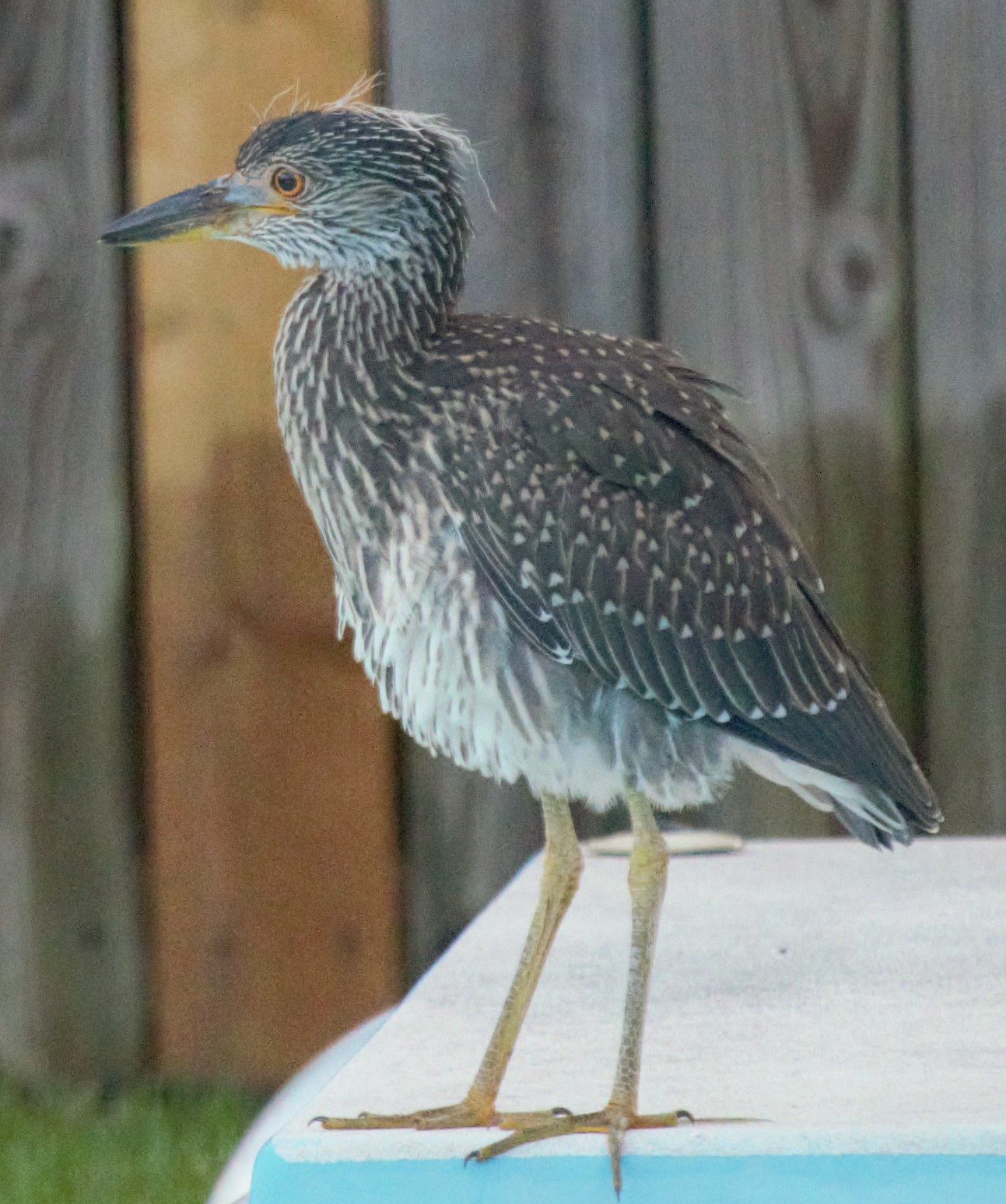
The next one is a young heron we think, that thought of using the swimming pool before changing his mind and flying off to greener pastures. In the picture he's standing on the diving board!


This guy is a baby Cattle Egret in the neighbor's yard. He started off in our window and then patrolled the neighborhood for a while. Someone said they thought his wing was injured and he was around until it healed enough to fly.


Last ones. Here is a lovely little thing that sang his heart out for a gal on another part of the fence. He didn't even mind when I came up to him with my camera.


Here she is...


And then finally the two of them together...

Sun and Moon, Part II

A few months ago, I posted the first steps I took toward a new story. You can find the original post here.

Today I want to share with you where the story is now. So, for your reading pleasure, here is the second step in the evolution of a short story. Rough story first, and then the background knowledge/World rules after that. It is important to set the ground rules before you write the story so you know what you can and cannot do for climaxes, roadblocks, and solutions. 

Story: 

Coronation and Ceremony

The hermit measured his steps on the long road, leaning on his gnarled cane when needed. His robe was a worn, yellow-ish crème color, though he could easily afford a newer one.

Apprentice Caden paced restlessly by his side. His robe was sparkling white. Even burdened by the pack on his back, Caden could have easily gone twice as fast, but he maintained a close distance to Father Barosh, who was also known by his official title, The Senior Emissary of the Sun.

Just two week ago, Caden had been apprentice to the third assistant Chandler. His duties had included delivering candles to other temples and merchants, not people. But circumstances changed after the Coronation of the New Sun, and here he was, shepherding the oldest Emissary he had ever seen. It was something of an honor, as this same man had presided over the Coronation. They were now on their way to another. As witness only, this time.

“Hurry up, Father. We don’t want to be late!” Other travelers, presumably headed to the same destination, passed them by. Some flew overhead, even though the sun was still above the horizon. It always puzzled the young apprentice how moonpower worked, even though the Sacred Sun was still in the sky. The Chandler had explained to him that it was because the moon was up in the heavens as well. As long as the moon was up there, moonpower worked. Caden looked, but saw no moon in the sky. Only the Sacred Sun.

“They won’t start without us, son,” Father Barosh said, interrupting his search. “No need to worry or hurry.”

“Where is the moon, Father?”

Without looking up from the road, Father Barosh responded. “It is hidden from us. The Ceremony of Moons is always performed during what they call the New Moon, when the moon is hidden in the sky.”

“Why?”

“Their ways are different from ours, son. While we have a Sun until he loses the Challenge, their rulers can serve again and again, just not continuously. They change as the moon changes, and that includes returning to things as they once were, much like the moon changes yet looks the same.”

“But why during the New Moon? Why are they doing it near the same time as the Challenge and Coronation? Why couldn’t they wait?”

“Perhaps you will find the answer to your question during the ceremony, young one.”

They continued walking. They had ridden much of the distance from the capitol, but the hermit insisted on walking the last stretch of the road. The ceremony would take place in the larger temple south of Trew, the nearest town.

The sun was setting as the temple’s outer walls appeared ahead. Caden looked at the Emissary in confusion, unsure, thinking it blasphemous to perform the sacred rights so close to a moon temple, but Father Barosh impelled him to his task with a wave of his hand. A few of the other travelers paused and watched respectfully as the apprentice performed the Farewell to the Sun for both himself and the Emissary. No one joined in. The hermit rested behind him on a boulder. 


Hefting the pack back onto his shoulders, the apprentice and the Emissary continued on in the twilight. People were rushing passed them now, eager to get a good seat for the ceremony soon to commence.

As the night grew stronger, it could be seen that the hermit was glowing slightly.


“Welcome honored guests. We are gathered here under the Hidden Luna, to change leadership from one to another. Just as Luna changes, so must we.”

Father Barosh, in his official capacity as Senior Emissary of the Sun, bestows the gift to the New Moon Mother as part of the ceremony. Earlier in the month, he had presided over the Coronation of the New Sun. It was a special duty of the Senior Emissary to bear a gift and to witness the ceremonies when they both occur in the same month.

Father Barosh and Apprentice Caden witness the peaceful turnover from old moon to new (coronation of the Moon mother). He had been present for the last four change overs occurring at the same time as the Challenge (24 years). [Dialogue here should foreshadow radiation discovery, and deterioration of the relationship between Sun and Moon]

***Five years pass***

He ran toward the sunset, toward Death.

Witches had flown out of the sky an hour after sunset, when even the last light of the Holy Sun was gone.

With no warning they overthrew the defenses and ransacked the temple. They flew among the columns and the rooms open to the air. Amber was depleted defending the temple, but losses among the witches were few. No one expected the witches to attack this temple! There was no cause! It was a quiet place, away from the mainstream, just full of hermits.

The Invisible Sun

He had dangerous knowledge, knowledge that would tip the balance in the Sun’s favor even more. His life was forfeit every night. In order to survive, he must find safe places, and workarounds for not being able to call on the sun in shade or shadow, and later on during the darkest nights. Stolen pieces of amber and sunflower seeds help. Sun magic can only be done while in sunlight.

He saw them. Witches in the sky. He ran. As he ran, his mind flashed back to his fever dream. He had been out in the sun too long, become delirious, but in his delirium, he realized that the sun must give out invisible rays that make it through the clouds and other barriers. These invisible rays could be used by those who knew of them. They gave even greater power to the sun mages. This is the knowledge that would cost him his life if the witches and warlocks found him.

He comes across a small village, where a mother is ready to give birth. He hides nearby and listens as he recovers and hydrates.

“Hurry! It’s almost noon!”

The midwife was an island of calm. “Nature must take its course, good sir. We cannot deliver the baby early or late, but only on time.” The hermit nodded, unseen. Countless stories are told of what happens if babies are forcibly born early or late. No power. The Sun does not like being played with.

Another male tried to cheer up the expectant father. “Maybe the witch was wrong? We can hope, right?”

The father-to-be stared at the stick. The stick’s shadow slowly disappeared. He yelled through the doorway to the midwife, “I don’t care what you have to do but get that baby out now!”

“Push!”

“Ahhh!”

The high-pitched cry of a newborn babe came through the doorway. “Waa! Waa!”

“It’s a girl.” He let out the breath he had been holding longer than he realized.

His friend sighed. “Ah geez. All that effort for nothing! A girl! During the day even! What a waste.”

“Uh-uh.” The father said nothing more as he paced back and forth, waiting to see his new child.

“Damn. An Untouched. Maybe you can marry her off?”

The father’s face told a different story. “I will love her, of course.”

The infant is brought out. He holds the precious bundle in his arms. “She is perfect. Not a boy, but she is already my heart and soul.” He smiled while his best friend scowled. “We will call her Anna.”

The hermit wasted some of his power and gave a blessing of invigoration and growth to the new child. She would be powerless, because women were not blessed with power from the Sun, and the moon was not in the sky, but she would be strong and healthy.

The Hermit continued running. He hoped to make it to neutral ground. A stone marker caught his eye. It was half-buried in the dirt by the roadside. He rubbed his hand over the carving depicting a bundle of reeds.

He was headed in the right direction.

He limped along, digging deep into his reserves to find the strength to continue.

Shadows appeared in the trees on either side of him. Unnatural shadows. They paced him, angling to intercept him before he reached his goal.

He limped faster.


The Place of the Reeds

He collapsed on the cold stones.

The shadows howled, but they dared not touch him now. Defeated, they slinked toward the large temple to the west.


He rested there on the stones, enjoying the chill they brought to his bones.

He knew where he was. He was on the Avenue of the Skies. It was a broad pathway of large stones that ran east to west, with a Temple of the Sun at the East end of the pathway and a Temple of the Moon at the west end. Smaller pyramids for the other powers in the sky were on either side of him, lining the pathway between the two large temples at the ends. The Sun temple ruins to his left was larger than all the other temples combined. This was the Place of Reeds, an ancient set of ruins built long ago.

The ruins are neutral ground, where meetings used to be held between followers of the Sun and followers of the Moon. The hermit remembered his training. The original builders are unknown but assumed to be Sun worshippers because of the pyramids, which followers of the moon do not build. Many believe that Followers of the Sun built the entire place as a peace offering.

The ruins were originally signified by carved images of a bundle of reeds tied together with a cord. The original name has been long lost. It has long been referred to as the Place of Reeds. It is thought that the carvings signified it was a good place for growing food and that many people were welcome.


Eclipse

The Day mages were charged with anger. “Chase the witches all the way to the ocean if you have to!”

First rule of war: Choose the battlefield. They ‘retreated’ toward the shore, toward the ocean.

The witches knew. They were in touch with the phases of the moon. They knew what was coming. The Heliomancers only cared that the sun would rise each day.

The Old Moon, the Moon Aunts and the soon-to-be Moon Mother led the fight.

The water crashed further inland, wiping out part of the solar forces. The moon mother’s knowledge of the tides had helped even the fight.

Three more Day mages charged the lines with fire in their eyes. They yelled louder and louder and blew themselves up, taking out a dozen witches on the southern flank.

All eyes were drawn toward the heavens. The skies grew dark as the Almighty Sun, the sun that always shines, was blocked and overpowered by the ever-changing Moon. Day turned into Night. The fireballs stopped. Men wept openly and were without power.

Did the witches and warlocks manage the inconceivable, stopping Luna in her tracks to overpower the sun? 


End