Random Quote

(Loading...)

Powered by Ink of Life

Tuesday, August 4, 2020

Tuberculosis versus COVID-19

04 AUG 2020
[for those who care about this sort of thing, this was also put out on my FB page as well. I decided to include it here for wider coverage]. Sorry in advance for yelling...

Tuberculosis (TB) vs Covid-19

I've seen too many shared posts about this. So let me see if this former science teacher can spread some truth...

There are posts going around saying "why are we shutting down the world for COVID-19 and not for TB?"

SHORT VERSION: You should worry about COVID-19 way more than TB. How much you worry about COVID-19 is up to you. A little over five hundred TB deaths in the US for 2017. COVID-19 US deaths in the last seven months: 159,000 and counting...You do the math...

*******************************************************

Some TB data: About 1.5 million people died from TB in 2018. That's a lot! This works out to more than 4,000 deaths a day due to TB in 2018. So how come we're all up in arms about COVID-19? Why not shut down the world for TB?

TB, if untreated, has a mortality rate of 45%! OH NO!

What's the mortality rate of COVID-19 you ask? Well, the easy answer is COVID-19 is too new to nail down the mortality rate. We don't know exactly how many cases there are, for several reasons. For example, not everyone is getting tested before/after passing away. Some reports estimate mortality rates for COVID-19 anywhere from 1.5% to 20%, with 20% being the super high range of the estimates for Wuhan, China, where the virus first showed up. Until we get more accurate numbers for who does and doesn't die from COVID-19, we won't be able to nail down the mortality rate for COVID-19 for a while yet.

But how about this to scare you a bit? The CDC is already pretty much guaranteeing COVID-19 is going to be one of the TOP TEN causes of death in the US for 2020. L.A. Country has already said this as well.

FYI: Here are the top 15 causes of death in the US for 2017 (lots of bad things on the list to watch out for -TB is not one of them):


1. Diseases of heart (HEART DISEASE) 647,457 deaths
2. Malignant neoplasms (CANCER)
3. Accidents (unintentional injuries, OOPSIES)
4. Chronic lower respiratory diseases 160,201 deaths
[current COVID-19 deaths in US is right here...]
5. Cerebrovascular diseases (stroke) 146,383 deaths
6. Alzheimer disease
7. Diabetes mellitus (diabetes)
8. Influenza and pneumonia (FLU)
9. Nephritis, nephrotic syndrome and nephrosis
(kidney disease)
10. Intentional self-harm (SUICIDE)
11. Chronic liver disease & cirrhosis (some by over-drinking)
12. Septicemia (blood poisoning)
13. Essential hypertension and hypertensive renal
disease (hypertension, HIGH BLOOD PRESSURE)
14. Parkinson disease
15. Pneumonitis due to solids and liquids (LUNG INFECTIONS)

TB, if untreated, has a mortality rate of 45%! Super deadly you say! BEWARE! But TB, unlike COVID-19, is not only PREVENTABLE, but it is also TREATABLE. WHO data says global success rate for people who started TB treatment in 2018 was 85%. The 45% mortality rate is for people who don't get treated for it.


So, TB, if untreated, is technically way way deadlier than COVID-19. Nearly half of the people with active, untreated TB disease may die, much more than even the highest mortality estimates for COVID-19.

So, how come we don't shut the world down for TB? Well, we have treatments that work for TB, even the drug-resistant varieties. Right now there are no proven treatments for COVID-19 except supportive treatment, however there are many trials underway right now that may lead to workable vaccines and care regimens.

Tuesday, July 28, 2020

New Story - Thieves' Oil

28 AUG 2020

[I started this post in May, but events, pandemic and otherwise, pushed it to the back burner until now...]

Starting off this post with a pair of quotations:

  • *Author Charles Godfrey Leland: "...witchcraft, like the truffle, grows best and has its raci[e]st flavour when most deeply hidden."
    • What a great way to conjure up an image through comparison.
  • Lactantius (an early Christian author who became an advisor to the first Christian Roman emperor, Constantine I): “Devils so work that things which are not, appear to men as if they were real.
    • What a great way description from back in the early beginning of the Christian religion.

Saturday, July 18, 2020

Through the Lens

Well, I just posted a short story in progress, and I was pretty happy with that side of my creativity, so let's do something else. I haven't posted pictures in a while, so here's a post of things I've seen and wish to share with others. 

First set are scenes from a chair. I believe this is slime mold. It was there after a long morning rain and vanished after a day of heat.


This next set are various creatures found in and around the house. One is my truck spider, an ordinary Yellow & Black Garden Spider that decided my truck bed would make a good home. He's logged some decent mileage and is still there. 

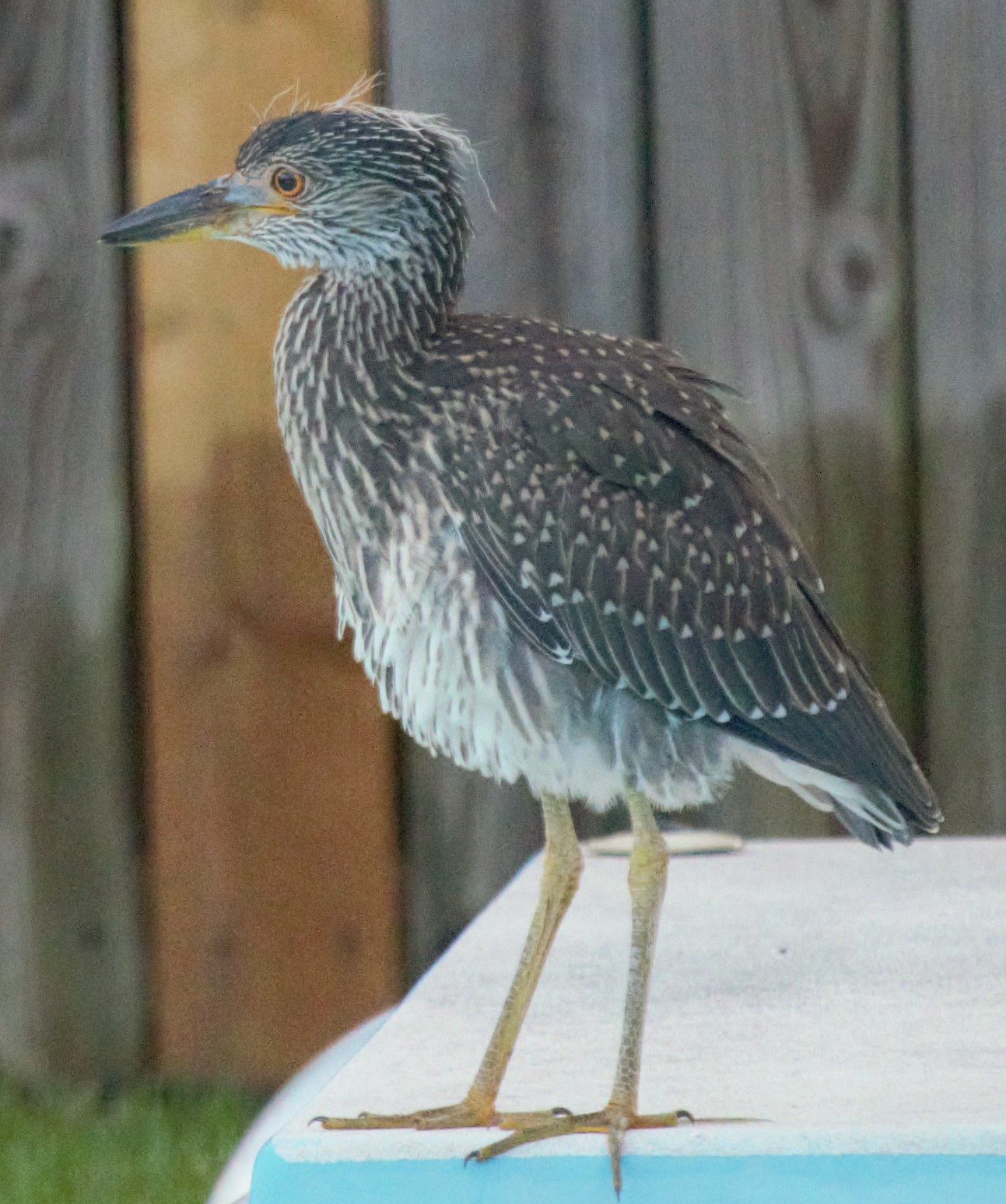
The next one is a young heron we think, that thought of using the swimming pool before changing his mind and flying off to greener pastures. In the picture he's standing on the diving board!


This guy is a baby Cattle Egret in the neighbor's yard. He started off in our window and then patrolled the neighborhood for a while. Someone said they thought his wing was injured and he was around until it healed enough to fly.


Last ones. Here is a lovely little thing that sang his heart out for a gal on another part of the fence. He didn't even mind when I came up to him with my camera.


Here she is...


And then finally the two of them together...

Sun and Moon, Part II

A few months ago, I posted the first steps I took toward a new story. You can find the original post here.

Today I want to share with you where the story is now. So, for your reading pleasure, here is the second step in the evolution of a short story. Rough story first, and then the background knowledge/World rules after that. It is important to set the ground rules before you write the story so you know what you can and cannot do for climaxes, roadblocks, and solutions. 

Story: 

Coronation and Ceremony

The hermit measured his steps on the long road, leaning on his gnarled cane when needed. His robe was a worn, yellow-ish crème color, though he could easily afford a newer one.

Apprentice Caden paced restlessly by his side. His robe was sparkling white. Even burdened by the pack on his back, Caden could have easily gone twice as fast, but he maintained a close distance to Father Barosh, who was also known by his official title, The Senior Emissary of the Sun.

Just two week ago, Caden had been apprentice to the third assistant Chandler. His duties had included delivering candles to other temples and merchants, not people. But circumstances changed after the Coronation of the New Sun, and here he was, shepherding the oldest Emissary he had ever seen. It was something of an honor, as this same man had presided over the Coronation. They were now on their way to another. As witness only, this time.

“Hurry up, Father. We don’t want to be late!” Other travelers, presumably headed to the same destination, passed them by. Some flew overhead, even though the sun was still above the horizon. It always puzzled the young apprentice how moonpower worked, even though the Sacred Sun was still in the sky. The Chandler had explained to him that it was because the moon was up in the heavens as well. As long as the moon was up there, moonpower worked. Caden looked, but saw no moon in the sky. Only the Sacred Sun.

“They won’t start without us, son,” Father Barosh said, interrupting his search. “No need to worry or hurry.”

“Where is the moon, Father?”

Without looking up from the road, Father Barosh responded. “It is hidden from us. The Ceremony of Moons is always performed during what they call the New Moon, when the moon is hidden in the sky.”

“Why?”

“Their ways are different from ours, son. While we have a Sun until he loses the Challenge, their rulers can serve again and again, just not continuously. They change as the moon changes, and that includes returning to things as they once were, much like the moon changes yet looks the same.”

“But why during the New Moon? Why are they doing it near the same time as the Challenge and Coronation? Why couldn’t they wait?”

“Perhaps you will find the answer to your question during the ceremony, young one.”

They continued walking. They had ridden much of the distance from the capitol, but the hermit insisted on walking the last stretch of the road. The ceremony would take place in the larger temple south of Trew, the nearest town.

The sun was setting as the temple’s outer walls appeared ahead. Caden looked at the Emissary in confusion, unsure, thinking it blasphemous to perform the sacred rights so close to a moon temple, but Father Barosh impelled him to his task with a wave of his hand. A few of the other travelers paused and watched respectfully as the apprentice performed the Farewell to the Sun for both himself and the Emissary. No one joined in. The hermit rested behind him on a boulder. 


Hefting the pack back onto his shoulders, the apprentice and the Emissary continued on in the twilight. People were rushing passed them now, eager to get a good seat for the ceremony soon to commence.

As the night grew stronger, it could be seen that the hermit was glowing slightly.


“Welcome honored guests. We are gathered here under the Hidden Luna, to change leadership from one to another. Just as Luna changes, so must we.”

Father Barosh, in his official capacity as Senior Emissary of the Sun, bestows the gift to the New Moon Mother as part of the ceremony. Earlier in the month, he had presided over the Coronation of the New Sun. It was a special duty of the Senior Emissary to bear a gift and to witness the ceremonies when they both occur in the same month.

Father Barosh and Apprentice Caden witness the peaceful turnover from old moon to new (coronation of the Moon mother). He had been present for the last four change overs occurring at the same time as the Challenge (24 years). [Dialogue here should foreshadow radiation discovery, and deterioration of the relationship between Sun and Moon]

***Five years pass***

He ran toward the sunset, toward Death.

Witches had flown out of the sky an hour after sunset, when even the last light of the Holy Sun was gone.

With no warning they overthrew the defenses and ransacked the temple. They flew among the columns and the rooms open to the air. Amber was depleted defending the temple, but losses among the witches were few. No one expected the witches to attack this temple! There was no cause! It was a quiet place, away from the mainstream, just full of hermits.

The Invisible Sun

He had dangerous knowledge, knowledge that would tip the balance in the Sun’s favor even more. His life was forfeit every night. In order to survive, he must find safe places, and workarounds for not being able to call on the sun in shade or shadow, and later on during the darkest nights. Stolen pieces of amber and sunflower seeds help. Sun magic can only be done while in sunlight.

He saw them. Witches in the sky. He ran. As he ran, his mind flashed back to his fever dream. He had been out in the sun too long, become delirious, but in his delirium, he realized that the sun must give out invisible rays that make it through the clouds and other barriers. These invisible rays could be used by those who knew of them. They gave even greater power to the sun mages. This is the knowledge that would cost him his life if the witches and warlocks found him.

He comes across a small village, where a mother is ready to give birth. He hides nearby and listens as he recovers and hydrates.

“Hurry! It’s almost noon!”

The midwife was an island of calm. “Nature must take its course, good sir. We cannot deliver the baby early or late, but only on time.” The hermit nodded, unseen. Countless stories are told of what happens if babies are forcibly born early or late. No power. The Sun does not like being played with.

Another male tried to cheer up the expectant father. “Maybe the witch was wrong? We can hope, right?”

The father-to-be stared at the stick. The stick’s shadow slowly disappeared. He yelled through the doorway to the midwife, “I don’t care what you have to do but get that baby out now!”

“Push!”

“Ahhh!”

The high-pitched cry of a newborn babe came through the doorway. “Waa! Waa!”

“It’s a girl.” He let out the breath he had been holding longer than he realized.

His friend sighed. “Ah geez. All that effort for nothing! A girl! During the day even! What a waste.”

“Uh-uh.” The father said nothing more as he paced back and forth, waiting to see his new child.

“Damn. An Untouched. Maybe you can marry her off?”

The father’s face told a different story. “I will love her, of course.”

The infant is brought out. He holds the precious bundle in his arms. “She is perfect. Not a boy, but she is already my heart and soul.” He smiled while his best friend scowled. “We will call her Anna.”

The hermit wasted some of his power and gave a blessing of invigoration and growth to the new child. She would be powerless, because women were not blessed with power from the Sun, and the moon was not in the sky, but she would be strong and healthy.

The Hermit continued running. He hoped to make it to neutral ground. A stone marker caught his eye. It was half-buried in the dirt by the roadside. He rubbed his hand over the carving depicting a bundle of reeds.

He was headed in the right direction.

He limped along, digging deep into his reserves to find the strength to continue.

Shadows appeared in the trees on either side of him. Unnatural shadows. They paced him, angling to intercept him before he reached his goal.

He limped faster.


The Place of the Reeds

He collapsed on the cold stones.

The shadows howled, but they dared not touch him now. Defeated, they slinked toward the large temple to the west.


He rested there on the stones, enjoying the chill they brought to his bones.

He knew where he was. He was on the Avenue of the Skies. It was a broad pathway of large stones that ran east to west, with a Temple of the Sun at the East end of the pathway and a Temple of the Moon at the west end. Smaller pyramids for the other powers in the sky were on either side of him, lining the pathway between the two large temples at the ends. The Sun temple ruins to his left was larger than all the other temples combined. This was the Place of Reeds, an ancient set of ruins built long ago.

The ruins are neutral ground, where meetings used to be held between followers of the Sun and followers of the Moon. The hermit remembered his training. The original builders are unknown but assumed to be Sun worshippers because of the pyramids, which followers of the moon do not build. Many believe that Followers of the Sun built the entire place as a peace offering.

The ruins were originally signified by carved images of a bundle of reeds tied together with a cord. The original name has been long lost. It has long been referred to as the Place of Reeds. It is thought that the carvings signified it was a good place for growing food and that many people were welcome.


Eclipse

The Day mages were charged with anger. “Chase the witches all the way to the ocean if you have to!”

First rule of war: Choose the battlefield. They ‘retreated’ toward the shore, toward the ocean.

The witches knew. They were in touch with the phases of the moon. They knew what was coming. The Heliomancers only cared that the sun would rise each day.

The Old Moon, the Moon Aunts and the soon-to-be Moon Mother led the fight.

The water crashed further inland, wiping out part of the solar forces. The moon mother’s knowledge of the tides had helped even the fight.

Three more Day mages charged the lines with fire in their eyes. They yelled louder and louder and blew themselves up, taking out a dozen witches on the southern flank.

All eyes were drawn toward the heavens. The skies grew dark as the Almighty Sun, the sun that always shines, was blocked and overpowered by the ever-changing Moon. Day turned into Night. The fireballs stopped. Men wept openly and were without power.

Did the witches and warlocks manage the inconceivable, stopping Luna in her tracks to overpower the sun? 


End

Sunday, July 5, 2020

Myths and Constellations

So at least one of my daughters loves the imaginary patterns of stars in the skies. Enough so that she can spend an evening gazing through her telescope, purring away like a cream-fat kitten. 

My favorite constellation is Orion, so one evening as we talked, she asked me to make up a new story about the constellations and the following is the result. Sit back and enjoy, all you stargazers, as I tell you an untold tale of Orion.

Thursday, June 4, 2020

Music and Mock Man Press


Looking from a window above, it's like a story of love
Can you hear me?
Came back only yesterday
I'm moving further away
Want you near me

All I needed was the love you gave
All I needed for another day
And all I ever knew

Only you

Oh how music can transport you! I was watching TV the other day with my wife and a song came on -immediately took me back decades. The song was from the band called Yaz in the states, Yazoo in the UK. Band members were also involved in Depeche Mode, Erasure, and some great solo works. Only You was the song that blew the dust off past times, not to take away anything from another great Only You song from 1968. Guess it's only fair to post the first two stanzas from The Platter's song as well: 

Only you can make all this world seem right
Only you can make the darkness bright
Only you and you alone
Can thrill me like you do
And fill my heart with love for only you

Only you can make all this change in me
For it's true, you are my destiny
When you hold my hand
I understand the magic that you do
You're my dream come true
My one and only you

Upstairs at Eric's is the name of the Yaz/Yahoo album. If you like Adele then you will love the lead singer of Yaz, Alison Moyet. They are very much like her. The song is a nice electronic ballad, the rest of the album ranges from the great to the odd but all good. It hearkens back to the days when you searched the 'imports' section of your local record store. Sometimes you were able to buy the singles of your favorites if they offered them for sale. In fact I remember buying a singles of one of Alison Moyet's later solo songs. My how things have changed. 

Both songs are wonderful examples of writing. The first song is minimal, impactful writing, the second more lyrical and scaffolded. I don't deal with love too much in my writing, not a fan of romance, but it is there of course. How can anyone not write about love? Love is one of the main driving forces in life! The seeking love of adventure, the passionate love between couples, the warmth of family ties. Maybe I should write more romancy stuff. It sells the best for sure. But that's not for me, I'll leave that to others. I write for me first, and hope that others enjoy my words. 

Picture for today: A recent purchase I am very happy with. This one is mine, go get your own! Jason Thompson, also known as Mock Man, drew a great black and white graphic telling of the Dream-quest of Unknown Kadath and a few other HPL stories. The book is available here. Follow the link to see beautiful pictures from the interior. The detail on each page is incredible and must be seen to be believed. One reason I love this purchase is I look forward to the day when drawings are made of my stories, whether it is from my own hand, my wife's considerable drawing talents, or from others.

HPL's The Dreamquest of Unknown Kadath & Other Stories
Mock Man as the great dreamer Randolph Carter

Monday, May 18, 2020

Rambo, Frankenstein, and Romeo & Juliet

18 MAY 2020

Today's post is inspiration for authors out there struggling to come up with new ideas. 
Point blank: There are no new ideas. 
Just write what you want to write and do it well! 

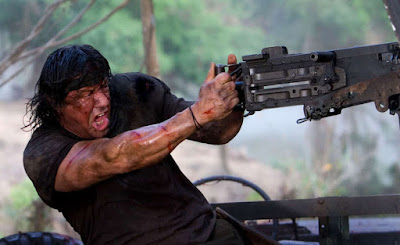
Short example: Did you know that Rambo loosely follows the story of Frankenstein? Think on that! Looks like Rambo's growling a little bit in the picture below. 
Rambo inspired by Frankenstein


Longer example: The classic tale of Romeo & Juliet takes its inspiration from an even older Greek Tale called Pyramus and Thisbe, which itself is based on an ancient tale set in a different city. Pyramis and Thisbe are neighbors that fall in love but are denied matrimonial union by their respective families. Tragedy ensues when they agree to meet but happenstance causes one to believe the other is already dead, which causes the other to commit suicide, which in turn leads to the other one to die as well. Tragic ending. The stories are not exactly the same, but you can clearly see the inspiration.

In the earliest tales, their passion and endings are used to explain the color change from white to blood color of the mulberry tree under which they ended their lives. The Greeks were big on stories that explained natural phenomenon (called origin myths or etiological myths).
"Why do mulberries change from white to red, Momma?" 
"Well..."

Read on to see Ovid's telling, and be inspired by his word choices and turns of phrase.

    
Thisbe, listening for her beau, Pyramus

The Tale of Pyramus and Thisbe:
(From Ovid's Metamorphosis)

In Babylon, where first her queen, for state
Rais'd walls of brick magnificently great,
Liv'd Pyramus, and Thisbe, lovely pair!
He found no eastern youth his equal there,
And she beyond the fairest nymph was fair.
A closer neighbourhood was never known,
Tho' two the houses, yet the roof was one.
Acquaintance grew, th' acquaintance they improve
To friendship, friendship ripen'd into love:
Love had been crown'd, but impotently mad,
What parents could not hinder, they forbad.
For with fierce flames young Pyramus still burn'd,
And grateful Thisbe flames as fierce return'd.
Aloud in words their thoughts they dare not break,
But silent stand; and silent looks can speak.
The fire of love the more it is supprest,
The more it glows, and rages in the breast.

When the division-wall was built, a chink
Was left, the cement unobserv'd to shrink.
So slight the cranny, that it still had been
For centuries unclos'd, because unseen.
But oh! what thing so small, so secret lies,
Which scapes, if form'd for love, a lover's eyes?
Ev'n in this narrow chink they quickly found
A friendly passage for a trackless sound.
Safely they told their sorrows, and their joys,
In whisper'd murmurs, and a dying noise,
By turns to catch each other's breath they strove,
And suck'd in all the balmy breeze of love.
Oft as on diff'rent sides they stood, they cry'd,
Malicious wall, thus lovers to divide!
Suppose, thou should'st a-while to us give place
To lock, and fasten in a close embrace:
But if too much to grant so sweet a bliss,
Indulge at least the pleasure of a kiss.
We scorn ingratitude: to thee, we know,
This safe conveyance of our minds we owe.


Pyramus and Thisbe conversing through a crack in the wall


Thus they their vain petition did renew
'Till night, and then they softly sigh'd adieu.
But first they strove to kiss, and that was all;
Their kisses dy'd untasted on the wall.
Soon as the morn had o'er the stars prevail'd,
And warm'd by Phoebus, flow'rs their dews exhal'd,
The lovers to their well-known place return,
Alike they suffer, and alike they mourn.
At last their parents they resolve to cheat
(If to deceive in love be call'd deceit),
To steal by night from home, and thence unknown
To seek the fields, and quit th' unfaithful town.
But, to prevent their wand'ring in the dark,
They both agree to fix upon a mark;
A mark, that could not their designs expose:
The tomb of Ninus was the mark they chose.
There they might rest secure beneath the shade,
Which boughs, with snowy fruit encumber'd, made:
A wide-spread mulberry its rise had took
Just on the margin of a gurgling brook.
Impatient for the friendly dusk they stay;
And chide the slowness of departing day;
In western seas down sunk at last the light,
From western seas up-rose the shades of night.
The loving Thisbe ev'n prevents the hour,
With cautious silence she unlocks the door,
And veils her face, and marching thro' the gloom
Swiftly arrives at th' assignation-tomb.
For still the fearful sex can fearless prove;
Boldly they act, if spirited by love.
When lo! a lioness rush'd o'er the plain,
Grimly besmear'd with blood of oxen slain:
And what to the dire sight new horrors brought,
To slake her thirst the neighb'ring spring she sought.
Which, by the moon, when trembling Thisbe spies,
Wing'd with her fear, swift, as the wind, she flies;
And in a cave recovers from her fright,
But drop'd her veil, confounded in her flight.
When sated with repeated draughts, again
The queen of beasts scour'd back along the plain,
She found the veil, and mouthing it all o'er,
With bloody jaws the lifeless prey she tore.

The youth, who could not cheat his guards so soon,
Late came, and noted by the glimm'ring moon
Some savage feet, new printed on the ground,
His cheeks turn'd pale, his limbs no vigour found;
But when, advancing on, the veil he spied
Distain'd with blood, and ghastly torn, he cried,
One night shall death to two young lovers give,
But she deserv'd unnumber'd years to live!
'Tis I am guilty, I have thee betray'd,
Who came not early, as my charming maid.
Whatever slew thee, I the cause remain,
I nam'd, and fix'd the place where thou wast slain.
Ye lions from your neighb'ring dens repair,
Pity the wretch, this impious body tear!
But cowards thus for death can idly cry;
The brave still have it in their pow'r to die.
Then to th' appointed tree he hastes away,
The veil first gather'd, tho' all rent it lay:
The veil all rent yet still it self endears,
He kist, and kissing, wash'd it with his tears.
Tho' rich (he cry'd) with many a precious stain,
Still from my blood a deeper tincture gain.
Then in his breast his shining sword he drown'd,
And fell supine, extended on the ground.
As out again the blade lie dying drew,
Out spun the blood, and streaming upwards flew.
So if a conduit-pipe e'er burst you saw,
Swift spring the gushing waters thro' the flaw:
Then spouting in a bow, they rise on high,
And a new fountain plays amid the sky.
The berries, stain'd with blood, began to show
A dark complexion, and forgot their snow;
While fatten'd with the flowing gore, the root
Was doom'd for ever to a purple fruit.

Mean-time poor Thisbe fear'd, so long she stay'd,
Her lover might suspect a perjur'd maid.
Her fright scarce o'er, she strove the youth to find
With ardent eyes, which spoke an ardent mind.
Already in his arms, she hears him sigh
At her destruction, which was once so nigh.
The tomb, the tree, but not the fruit she knew,
The fruit she doubted for its alter'd hue.
Still as she doubts, her eyes a body found
Quiv'ring in death, and gasping on the ground.
She started back, the red her cheeks forsook,
And ev'ry nerve with thrilling horrors shook.
So trembles the smooth surface of the seas,
If brush'd o'er gently with a rising breeze.
But when her view her bleeding love confest,
She shriek'd, she tore her hair, she beat her breast.
She rais'd the body, and embrac'd it round,
And bath'd with tears unfeign'd the gaping wound.
Then her warm lips to the cold face apply'd,
And is it thus, ah! thus we meet, she cry'd!
My Pyramus! whence sprung thy cruel fate?
My Pyramus!-ah! speak, ere 'tis too late.
I, thy own Thisbe, but one word implore,
One word thy Thisbe never ask'd before.
At Thisbe's name, awak'd, he open'd wide
His dying eyes; with dying eyes he try'd
On her to dwell, but clos'd them slow, and dy'd.

The fatal cause was now at last explor'd,
Her veil she knew, and saw his sheathless sword:
From thy own hand thy ruin thou hast found,
She said, but love first taught that hand to wound,
Ev'n I for thee as bold a hand can show,
And love, which shall as true direct the blow.
I will against the woman's weakness strive,
And never thee, lamented youth, survive.
The world may say, I caus'd, alas! thy death,
But saw thee breathless, and resign'd my breath.
Fate, tho' it conquers, shall no triumph gain,
Fate, that divides us, still divides in vain.

Now, both our cruel parents, hear my pray'r;
My pray'r to offer for us both I dare;
Oh! see our ashes in one urn confin'd,
Whom love at first, and fate at last has join'd.
The bliss, you envy'd, is not our request;
Lovers, when dead, may sure together rest.
Thou, tree, where now one lifeless lump is laid,
Ere-long o'er two shalt cast a friendly shade.
Still let our loves from thee be understood,
Still witness in thy purple fruit our blood.
She spoke, and in her bosom plung'd the sword,
All warm and reeking from its slaughter'd lord.
The pray'r, which dying Thisbe had preferr'd,
Both Gods, and parents, with compassion heard.
The whiteness of the mulberry soon fled,
And rip'ning, sadden'd in a dusky red:
While both their parents their lost children mourn,
And mix their ashes in one golden urn.

Thus did the melancholy tale conclude,
And a short, silent interval ensu'd.
The next in birth unloos'd her artful tongue,
And drew attentive all the sister-throng.